
The next big thing in 2026 will be...
Technology's top thinkers weigh in on the year ahead.

Welcome to issue #62 of next big thing.
I very much enjoy the process of pinging leaders whose thinking I respect to gather predictions for the new year. If you’re interested in looking back, here’s the archive of these year-end posts from 2025, 2024, 2023, 2022, and 2021.
This year’s contributions are from the founders of companies like Applied Intuition, Instacart, and NVIDIA, leaders at companies including Canva and OpenAI, and venture capitalists at firms such as a16z, Emergence, and USV.
AI once again dominates the themes, with predictions that reasoning models will yield meaningful advances for applications, AI will show up in bottom line ROI for businesses, and that memory and proactivity will lead to better AI experiences. There is optimism for consumer technology having a renaissance, for AI moving further into the physical world, and for AI yielding scientific discoveries. And in our world of startups and venture capital investing, there is the expectation of a robust capital markets environment, with much-awaited IPOs and significant M&A in 2026.
Happy New Year!
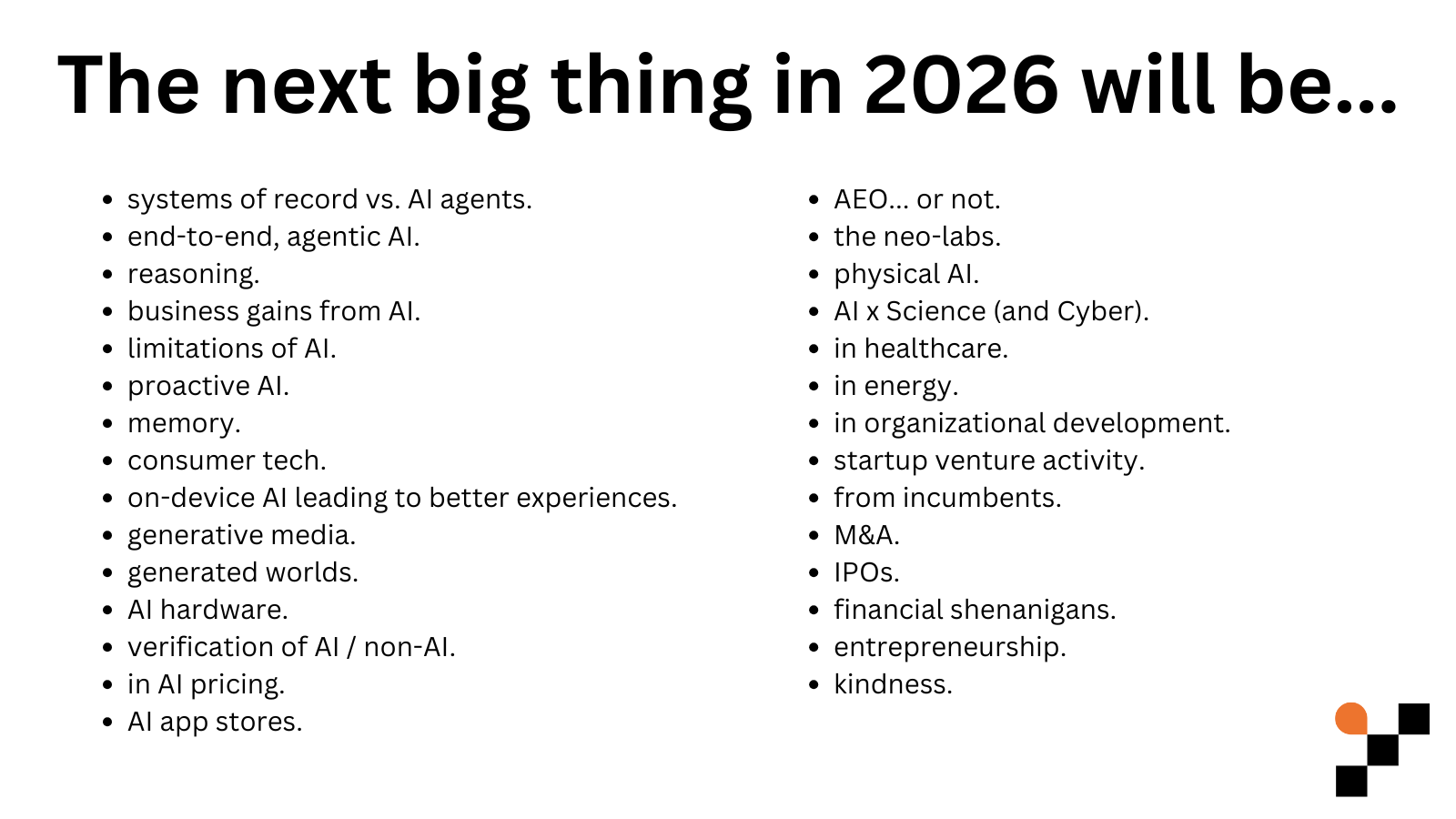
… systems of record vs. AI agents.
The next big thing in 2026 will be an escalation in the battle between Systems of Record companies and AI agent companies. Slack fired a shot across the bow in 2025 by blocking Glean, but we’ll see this ratcheted up as Systems of Record start blocking 3rd party AI agent access to data, start charging hefty fees, and most importantly, start building AI agents themselves and bundling them for free or cheaply with their core offering. On the other hand, AI agents will start bypassing APIs (and associated fees) through computer use automation, pulling in data - traditionally associated with systems of record - into their own systems, and putting their own interfaces around this data. Legal and Healthcare are the two areas where we’ll see this battle play out the strongest in 2026.
-Gokul Rajaram, Founding Partner at Marathon Management
… end-to-end, agentic AI.
The next big thing in 2026 will be autonomous computing — AI that doesn’t just respond but operates. Every major AI lab will ship consumer-facing computer use, and at least one company built for non-developers will hit a $1B+ valuation doing it.
-John Milinovich, Head of Product, GenAI at Canva
The next big thing in 2026 will be a shift from copilots to pilots. Behavior + comfort + capabilities will usher in a shift from AI as copilots (AI assistants selling into and helping the doctor, lawyer at the law firm, accounting firm) to pilots that take over the work and turn the markets towards the end user with full stack approach. The best will give away lots of value for free, transforming the structures of these markets, with monetization coming through the handoff to humans when they need to step in.
-Rebecca Kaden, General Partner at USV
The next big thing in 2026 will be AI systems that replace entire workflows, not individual tasks. Not smarter chat. Not better demos. End-to-end agents that own outcomes, not prompts.
-ChatGPT 5.2, prompted based on everything I learned in 2025
The next big thing in 2026 will be AI agents that own end-to-end business processes. Not just chatbots or single-function AI tools, but autonomous agents that can execute complete workflows. We’re moving from “AI that helps” to “AI that does” - agents that can reason across long horizons, coordinate with other agents, and actually replace entire job functions rather than just augmenting them. The infrastructure is finally there, the economic pressure is real (companies need efficiency gains), and your portfolio companies are proving the market demand exists. The companies winning in 2026 won’t be selling AI features - they’ll be selling business outcomes delivered autonomously by AI agents.
-Granola, prompted based on everything I learned in 2025
… reasoning.
The next big thing in 2026 will be reasoning systems translating directly into AIs that are more versatile and robust. Reasoning will impact not just large language models, but every single industry, from biology to self-driving cars to robotics.
-Jensen Huang, Co-Founder & CEO at NVIDIA (via No Priors)
The next big thing in 2026 will be AI application companies that use reasoning as a core primitive. To date, reasoning models have primarily been used to enhance the capabilities of existing products (e.g., in legal and support). In 2026, we’ll begin to see companies whose core product was fundamentally unlocked by the advances in reasoning models.
-Kimberly Tan, Partner at a16z
… business gains from AI.
The next big thing in 2026 will be AI showing up in the bottom line, not just the top line. As capabilities expand into knowledge work tasks outside of coding, large companies will see tangible profitability and operational improvements from AI adoption.
-Aashay Sanghvi, Partner at Haystack
The next big thing in 2026 will be the deployment inflection: autonomous agents operate independently across knowledge work, adding measurable points to GDP, and expanding to long duration, complex tasks. Meanwhile, AI starts to hit the physical world: robots begin to move out the lab and ship the first production-ready, end-to-end systems into biopharma labs, manufacturing lines, and logistics warehouses. Not prototypes. Not pilots. Revenue-generating deployments that deliver ROI.
-Talia Goldberg, Partner at Bessemer Venture Partners
… limitations of AI.
The next big thing in 2026 will be a reckoning for AI-enabled services.
The category soaked up venture dollars on a bold promise: unlock TAMs an order of magnitude larger than SaaS while preserving software-like gross margins. The catch? Unlike SaaS, rapid revenue growth and strong logo retention don’t prove product–market fit.
You only truly have it when AI is doing a material share of the work at high gross margin. Otherwise, you’ve built a good services firm financed with the wrong kind of capital.
That distinction stops being theoretical in 2026, when these companies return to market for growth rounds. Investors will stop underwriting the promise of AI-enabled delivery and start underwriting proof in the P&L that machines, not armies of humans, are carrying the load.
Some of today’s fastest-growing, best-branded AI services companies will stall, take painful terms, or quietly sell when it becomes clear they’re still mostly human-powered.
The shakeout will be uncomfortable but healthy. It will force founders to shift from bespoke customer work to internal AI leverage, choosing the important over the merely urgent. And it will distinguish AI that compounds from labor that merely scales.
That’s a feature, not a bug. AI-enabled services remain one of the most promising new business models in decades, and 2026 is when the winners will finally earn their multiples.
-Jake Saper, General Partner at Emergence Capital
The next big thing in 2026 will be AI as intelligent as the smartest PhD in any domain, but still not knowing your business. Structured and unstructured context will enable AI to transform business intelligence.
-Jamie Davidson, Co-Founder at Omni
The next big thing in 2026 will be deployment as AI’s bottleneck. Next year the challenge in AI will move from capabilities to deployment. By now Improving the models is much less important than deploying/implementing the technology across the real economy and 2026 will be the year that deployment emerges as the major bottleneck to true acceleration.
-Yoni Rechtman, Partner at Slow Ventures
… proactive AI.
The next big thing in 2026 will be AI that watches how we work and makes it better without being asked (which is both amazing and terrifying).
-Katie Jacobs Stanton, Founder at Moxxie Ventures
The next big thing in 2026 will be proactive AI agents. They’ll have good ideas before you do—and you’ll start to trust them. Over time, you’ll rely on AI not just to organize your inbox and calendar, but to decide what’s worth your attention at all, quietly shaping everything from daily priorities to major purchases.
-Max Mullen, Co-Founder at Instacart
… memory.
The next big thing in 2026 will be memory.
AI applications to date have been interesting, but the real breakout hits will come once product designers figure out how to use memory in original ways. I wrote about this in “Memory Is the New Moat,” but the core idea is that consumers are increasingly willing to give developers deep access to their digital lives in exchange for products that are more personalized, predictive, and useful.
When the mobile platform shift happened, it took years for developers to understand GPS, location, and “on-the-go” use cases. Then it clicked and we got Uber, DoorDash, Tinder, and entire categories that only exist because phones know where you are and live in your pocket 24/7.
We’re in the same place today with AI. Models are powerful, but we still haven’t learned how to use memory to build genuinely new products. In 2026, the best apps will remember conversations, emails, documents, preferences, context, history, and intent.
What a time to be alive if you love building products.
-Jeff Morris Jr., Founder at Chapter One
The next big thing in 2026 will be Memory becoming the new moat in AI. In 2026, companies will split into two camps: those who treat memory as a strategic asset and others who don’t. Winners will figure out their memory strategy and use it to increase engagement & retention. A/B Tests with and without memory activated will show large differences in bounded retention and session length.
-Mercedes Bent, Co-Founder at Premise
The next big thing in 2026 will be AI companions that actually know you. Not chatbots that forget yesterday’s conversation. Not assistants that need constant reminding. I’m talking about AI that remembers your mom’s birthday is coming up, knows you’re stressed about the project due next week, recalls that joke you made three months ago, and understands the subtle ways your preferences have evolved over time. We’ve spent 2024-2025 figuring out how to make AI smart. 2026 is when we make it present. When memory becomes persistent and personalized, AI stops being a tool you use and starts being a presence in your life. Think less “search engine” and more “that friend who somehow always remembers the important stuff.” The future isn’t AI that can do everything. It’s AI that remembers everything about you.
-Claude Sonnet 4.5
… consumer tech.
The next big thing in 2026 will be a set of startups that radically re-imagine existing consumer categories like travel, finance, healthcare, and maybe even real estate. The other shift will be from search-driven experiences to AI systems that proactively observe, suggest, and act on a user’s behalf. Instead of asking for answers, consumers will increasingly delegate intent—granting AI permission to notice opportunities, prepare decisions, and execute with approval. The winners will feel less like apps and more like trusted agents.
-Saar Gur, General Partner at CRV
The next big thing in 2026 will be a huge increase in AI toys and AI digital and physical products for kids & teens. Some already have been hugely successful like Stickerbox. But I think we’ll see a lot more of this type of thing (the younger someone is the least un-natural it feels to have AI entertainment, an AI companion, AI best friend, etc).
-Tony Staehelin, Founder & CEO at Benable
The next big thing in 2026 will be a consumer startup renaissance. We will see more tech founders get started than ever before the previous 10 years. More importantly for the consumer startup founders who are 1-2 years into the journey we shall see a handful of them get to $100m+ revenue run rate.
-Niko Bonatsos, Managing Director at General Catalyst
The next big thing in 2026 will be a fresh boom of consumer platforms. Boredom with older platforms + curiosity at what new tools can create + continued desire for connection and the new will usher this in. After a long stretch of it being too hard to interrupt incumbents, the cracks are showing and the newer, the weirder the better as we crave new consumer digital experiences and connection.
-Rebecca Kaden, General Partner at USV
.. on-device AI leading to better experiences.
The next big thing in 2026 will be taste graphs. For 20 years, consumer tech was built around social graphs. Who you know. What’s been missing is a real model of what you value. Taste shows up in patterns over time, not in prompts. AI agents won’t work without that layer. On-device AI finally makes it possible to learn taste privately and continuously. 2026 is when on-device capability, agent adoption, privacy expectations finally converge. Social graphs shaped attention. Taste graphs will shape action.
-Kirsten Green, Founder & Managing Partner at Forerunner
The next big thing in 2026 will be real experimentation and adoption of local inference. This is the inevitable result of demand for longer inference-time compute runs, open-source reasoning models reaching SOTA status, and these frontier models becoming increasingly accessible on consumer-grade hardware.
-Sumeet Singh, Founder & Managing Partner at Worldbuild
… generative media.
The next big thing in 2026 will be generative media, with image, video, audio, and 3D models (finally) ready to underpin an explosion in applications. Companies like Fal have become critical infrastructure players, but we’re now ready to see the app layer take center stage.
-Rex Woodbury, Founder & Managing Partner at Daybreak
The next big thing in 2026 will be AI video ads. They may overtake non-AI video ads on social networks in 2026.
-Kanyi Maqubela, Co-Founder & Managing Partner at Kindred Ventures
… generated worlds.
The next big thing in 2026 will be Generated Worlds. World models are the most slept-on development in AI right now.
Entertainment hasn’t changed in decades. Whether you’re in Tokyo or Toledo, you watch identical pixels, follow identical stories. Same heroes, same quests, same endings. We spend more time than ever staring at screens, yet every screen shows the same thing.
That’s about to break. World Labs launched Marble, turning prompts into explorable 3D environments. Google’s Genie 3 generates playable worlds that respond as you move through them. Last week, Runway released GWM-1, their own world model with explorable environments and conversational avatars. Meta shipped consumer glasses with displays this fall. Each piece exists. None talk to each other yet.
In 2026, I expect them to finally break through. We’ll see our first entertainment that generates uniquely for each viewer. Not recommendations of existing content, but stories, characters, and worlds that exist only for you. The economics will make sense: Netflix spends $17 billion annually chasing a median viewer who doesn’t exist. Personalized generation will cost less than streaming pre-made content.
We’ll see a glimpse of why our kids will never understand why movies weren’t made just for them.
-Nikunj Kothari, Partner at FPV Ventures
… AI hardware.
The next big thing in 2026 will be AI Wearables - Jony Ive’s new launch, Meta RayBan + other products will reach peak fever. There’s a feeling that the AI revolution constitutes the start of a tech leap that’s just a bit....unfinished. We have all the makings of new intelligence, but it’s stuck in our mid 2000 era phones.
-Mercedes Bent, Co-Founder at Premise
The next big thing in 2026 will be AI hardware starting to make sense. My bet is on the Daylight being the first consumer device to create something sincerely magical here.
-Mario Gabriele, Founder at The Generalist
… verification of AI / non-AI.
The next big thing in 2026 will be verification and provenance becoming core product features on most platforms. As synthetic media explodes products and platforms start really emphasizing ‘this came from a real human’ (eg verified non-AI badge).
-Tony Staehelin, Founder & CEO at Benable
… in AI pricing.
The next big thing in 2026 will be aligning AI pricing with the nature of the work. We are moving past the blunt instrument of seats, but we must be careful not to blindly rush into outcomes. Outcome-based pricing is the ultimate goal, but it is a privilege earned through High Autonomy, meaning true auto pilot behavior, and High Attribution, meaning clearly proven value. For many companies, the strategic bridge will be credit-based models, which offer the predictability of SaaS with the fairness of usage. The winners will not be those with the smartest models, but those with the smartest monetization architectures, mapping pricing to autonomy versus attribution and charging for tasks where they must and outcomes where they can.
-Madhavan Ramanujam, Co-Founder & General Partner at 49 Palms Ventures
… AI app stores.
The next big thing in 2026 will be the OpenAI App Store. Fidji Simo’s hire by OpenAI was all the indication the tech crowd needed and their 2025 fall announcements show with 7 brand partners doubled down. The main thing I’m watching is how larger incumbents reach to sense they’re being disintermediated by OpenAI - how do brands contend with ChatGPT’s embedded app experience taking away native primacy?
-Mercedes Bent, Co-Founder at Premise
… AEO... or not.
The next big thing in 2026 will be an AEO boom and confusion. The conversation going on right now in every retail and local business strategy room (from Jeni’s Ice Cream to Lululemon) is how to rank better in the new AI platforms. Budgets will be big here, results hard to track, and not nearly as predictable as SEO.
-Tony Staehelin, Founder & CEO at Benable
… the neo-labs.
The next big thing in 2026 will be the rise of the neo-lab. A new crop of foundation model companies will spring up, as leading researchers from the existing large labs (Deepmind, Anthropic, OpenAI, etc) branch out to start their own model companies, all with some hypothesis on a new type of research breakthrough they want to double down on
-Jamin Ball, Partner at Altimeter Capital
… physical AI.
The next big thing in 2026 will be Physical AI. This is taking artificial intelligence beyond text and into the real world. It’s about bringing intelligence to the machines that move us and protect us, and that make and deliver the goods we rely on. That’s cars. That’s trucks. That’s fighter jets. That’s drones. That’s robots. The impact of this will change everything. Intelligent machines, for example, will transform the global supply chain, coordinating together into a single intelligent system that’s more sustainable and efficient. It will transform cities as autonomous vehicles become the norm. AI has already made a huge impact in our daily lives. But that impact is only going to be magnified as intelligence makes it into the physical world.
-Qasar Younis, Founder & CEO at Applied Intuition
The next big thing in 2026 will be the Waymoification of the real world. You’ll see AI autonomously pilot more, and increasingly larger, things around you. You’ll pass a construction site and see an excavator moving dirt with no one in the driver’s cab…
-Jake Saper, General Partner at Emergence Capital
… AI x Science (and Cyber).
The next big thing in 2026 will be AI and Science! I think what happened with software engineering last year will happen with science this year and it’s going to be super exciting.
-Kevin Weil, VP Science at OpenAI
The next big thing in 2026 will be the first credible, end-to-end scientific result produced by an autonomous system, from hypothesis generation through iterative experimentation to peer-reviewed publication, alongside the first truly destabilizing AI-enabled cyber or information operation that forces international escalation. Of note, is is likely that they won’t be unrelated events. The same capabilities that enable agents reason, plan, and act across complex systems will prove productive in science and dangerous in security.
-Nathan Benaich, Founder at Air Street Capital
… in healthcare.
The next big thing in 2026 will be a significant shift in both functionality, accessibility and regulatory ability for AI to prescribe directly, allowing swaths of full healthcare experiences to be delivered without human touch. Over time, this will change the cost structure and accessibility of care.
-Rebecca Kaden, General Partner at USV
The next big thing in 2026 will be in healthcare. Silicon Valley has had lots of false starts where it believed technology would disrupt healthcare -- but fundamentally it’s still an industry using fax machines. AI is different. The first big wins won’t be flashy: in 2026, AI for back-office automation plays (that move the needle financially for large healthcare incumbents) will start to break out. We’ll also start to see signals of a few bigger disruptions -- AI-based diagnostics and consumer-centric healthcare companies -- that will make a bigger shift in the industry long-term.
-Travis May, Founder & CEO at Shaper Capital
… in energy.
The next big thing in 2026 will be in energy. The need for abundant, cheaper, and, ideally, cleaner energy only continues to explode given the rapid growth of AI leading to increased innovation in each piece of the programmable energy market—new forms of energy, how it’s orchestrated and delivered. We see a rapid rise in all buildings needing batteries, creating massive opportunity for new solutions to deliver and install them and also build on top of that network.
-Rebecca Kaden, General Partner at USV
… in organizational development.
The next big thing in 2026 will be defying the burden of change management proving to be a top moat in the AI era. When the game is changed - in terms of new platform shifting, a new playbook for marketing in your industry, or modern organizational practices - the realizations themselves are surprisingly evenly distributed. People are more networked than ever before, journalists tout and merchandise the breakthroughs, and consultants capitalize on moments like these. However, switching up the gears of execution takes many years. Change management is human rewiring, not technical. Change management never happens naturally. On the contrary, the ancestral lizard brain in all of us recoils from change by default. As a result, teams without the burden of change management gain the most advantage during generational platform shifts. As a larger and established company, the only way to transcend this outcome is the willingness and might to hack the organization from the top down - the proverbial “founder mode” as Brian Chesky calls it. Transplants of strategy, mission, and practice are just that: transplants. The healthier the organization, the more they require blunting the immune system in the form of a painfully clear narrative, hacked reward systems, and relentless execution. The companies that win in the AI era will be either brand new (and void of change management) or able to undergo serious and fast change within - often with the help of a founder or refounder.
- Scott Belsky, Founder of Behance, Author/Investor, Partner at A24
The next big thing in 2026 will be the end of the “two-pizza team.” The atomic unit of execution inside companies collapses to a one-person squad; a ‘full-stack operator.’ As AI reduces the cost of execution to near zero, the right person can out-build a 50-person org. The bottleneck becomes finding full-stack operators with curiosity, taste, and judgment.
-Sam Chaudhary, Co-Founder & CEO at ClassDojo
The next big thing in 2026 will be promotions. The early adopters of AI are breaking out as top performers at their company. We’re seeing across the portfolio in-house legal professionals, marketers, and all types of workers reduce outside spend by 40% or more. Top performers aren’t just doing good work, they’re cutting back on spend and generating more revenue than ever before. They have meaningful leverage going into annual performance reviews.
-Brianne Kimmel, Founder at Worklife Ventures
… startup venture activity.
The next big thing in 2026 will be a meaningful increase in venture activity. The “public AI trade” will roar back, GDP growth will keep coming in strong, inflation will come in lower, interest rates will drop - all leading to another big spike in venture market activity. The “hottest” companies will raise 3+ rounds in 12 month periods (and increasingly two rounds at once in tranched structures), and valuations will soar across everything from venture to growth stage investments. VC funds will race to raise larger and larger pools of capital, and by the end of the year we’ll all be saying “how could we do this again, 2021 wasn’t that long ago.” That being said - despite all of this, some of the best venture investments of all time will be made in 2026.
-Jamin Ball, Partner at Altimeter Capital
… from incumbents.
The next big thing in 2026 will be the empire striking back. If the last two years have been dominated by discourse about the foundation model players and AI-native companies growing like crazy, in 2026 the pendulum will swing back to the incumbents who will layer in strategic M&A with their existing distribution.
-Shravan Narayen, Partner at IVP
… M&A.
The next big thing in 2026 will be acquisitions by the large AI labs being the main way that venture-backed companies will achieve large exits. Startups have a window of opportunity to gather industry-specific data and context by building and distributing vertical-specific applications. Over time, the AI labs will want to suck up this context and data themselves and will aggressively acquire these businesses.
-Damir Becirovic, Founding Partner at Relentless
… IPOs.
The next big thing in 2026 will be IPOs and liquidity. OpenAI has no choice but to go public, Anthropic has plans, Databricks, for the first time said “they don’t rule out going public by the end of 2026.” And lots of mid-cap businesses will be emboldened to go out once the “generals” go. This is good for the overall US economy, and for limited partners.
-Ram Parameswaran, Founder at Octahedron Capital
The next big thing in 2026 will be the return of banner tech IPOs and related IPO hijinks, from mascots to VCs and former execs jostling for a listing day invite. (Looking at you, SpaceX, Databricks, Anthropic etc.) This will have 3 main consequences: 1) the latest round of hand-wringing and arguing about IPO ‘pops’ and lots of people tagging Bill Gurley on X; 2) a massive round of VC victory laps releasing years of pent-up, illiquid frustration; 3) newly-minted employee billionaires launch more startups, angel invest in each other again, and pay for subscriptions to upstartsmedia.com.
-Alex Konrad, Founder & Editor at Upstarts Media
… financial shenanigans.
The next big thing in 2026 will be the world relearning about Financial Shenanigans and why accounting is actually important.
-Shravan Narayen, Partner at IVP
… entrepreneurship.
The next big thing in 2026 will be regular people shipping large software businesses ($1m+ revenue) with AI.
-Dhruv Amin, Co-Founder at Anything
The next big thing in 2026 will be the enablement through AI of a new era of creators, in content and in code. We’ll see the first independent content creator go viral through primarily AI-generated content. And we’ll see new organizational structures emerge because more people can now ship products end to end.
-Chetan Narain, Co-Founder at Pepper
… kindness.
The next big thing in 2026 will be Kindness. Apolitical, nondenominational, online and offline kindness. Mainstream tech population is exhausted by the escalations of the last decade. Begins investing time and energy in more community, civics, and charity. Leaves the most toxic social spaces to trolls and bots. And this is aided by AI, because when chatting, its default is more polite - which subtly influences the auto-completes and auto-replies we send, as well as retrains us to be a little nicer generally. The etiquette dividend of the AI boom!
-Hunter Walk, Co-Founder & Partner at Homebrew
I started next big thing to share unfiltered thoughts. I’d love your feedback, questions, and comments!
👇🏽 please hit the ♥️ button below if you enjoyed this post.
VERY biased but my answer is the best one
@Gokul & @Nikhil prediction about Systems of Record vs. AI Agents is the one I keep coming back to. But I think there's a missing layer in that battle.
Systems of Record capture what happened. AI Agents execute what should happen. But neither captures why we decided.
That's the gap. When an LP asks "how did you make that call?" — Affinity can't answer it. ChatGPT can't answer it. The reasoning lives in IC discussions, Slack threads, and institutional memory that walks out the door when a senior partner retires.
Jeff Morris and Mercedes are right that memory becomes the moat. But for institutions, it's not just personal memory — it's decision memory. The audit trail of judgment that compounds over decades.
This is exactly what we're building at @Quantum Mosaic — decision infrastructure for institutional capital. We call it the "Judgment OS": encode how decisions get made, enforce consistency across teams, and evidence outcomes for LPs and regulators. The companies that own the decision graph — not just the relationship graph or the deal analytics — will own the infrastructure layer between SoRs and AI agents.
Foundation Capital published their "Context Graphs" thesis in December describing this exact gap. a16z's Big Ideas 2026 called for "systems of coordination" to manage multi-agent interactions. The category is emerging in real-time.
Excited to see how 2026 plays out — and to be building in the middle of it.
— Deepak Jha, Founder & CEO, Quantum Mosaic