

Welcome to issue #72 of next big thing.
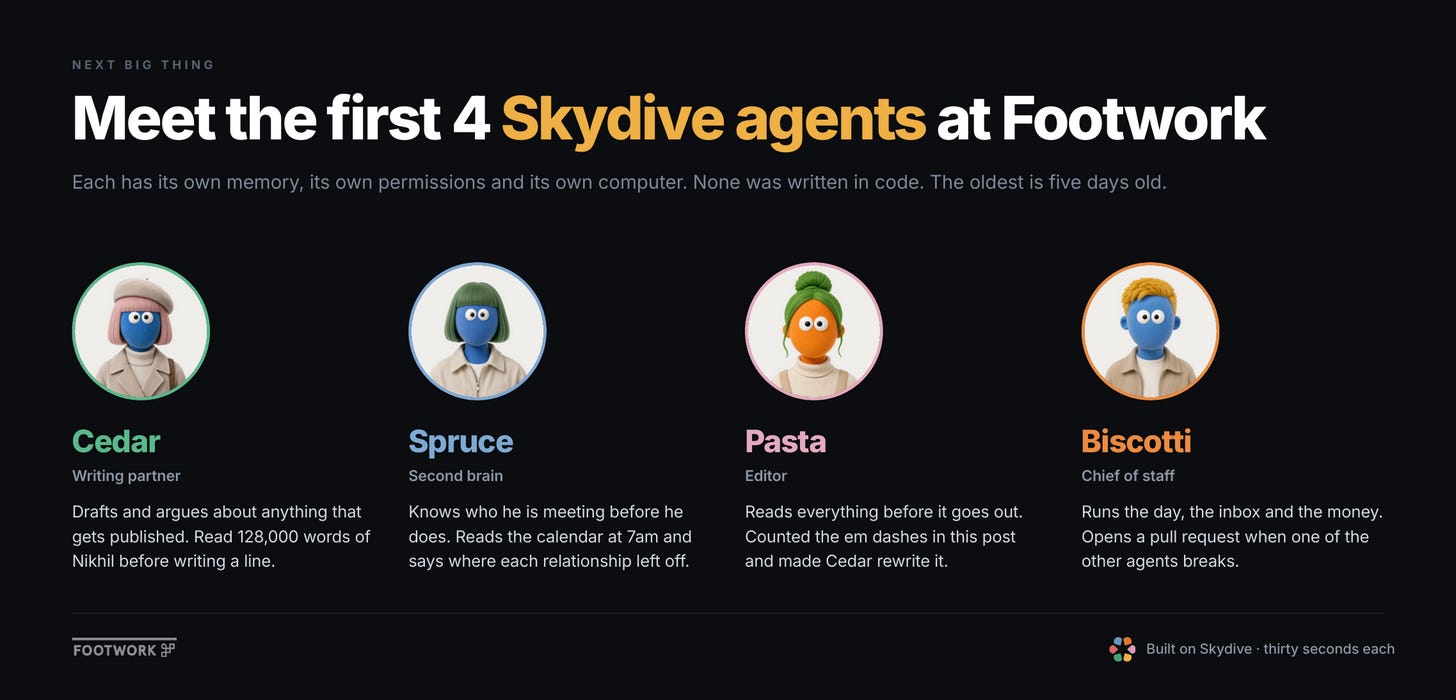
For the first time in next big thing’s history, I did not write the first draft of this post. An AI agent named Cedar did, and Cedar was created a few days ago to be my writing partner by Spruce, another agent that I created last week to be my second brain.
Before it drafted a word, Cedar went and read everything I have published here since 2020 — 94 posts and 128,000 words — along with my tweets and LinkedIn posts, and it built itself a guide to how I write.
Then Cedar wrote a draft, and three other agents in our Slack read it and sent notes back before it ever reached me. One of them measured the draft against the guide Cedar had written and found that Cedar had missed its own numbers, running at five times my em dash rate and two thirds of my sentence length. Another pointed out that the argument in the middle of the post was true but was being supported by the weaker of the two available reasons. Cedar rewrote it. The whole exchange happened while I was in meetings.
Those four agents run on Skydive, which launches today, and which is the latest product from the team at Anything, a company Footwork partnered with last year.
What Skydive is
Skydive is a platform that lets anyone at a company create AI agents to automate real work. You describe a role, and thirty seconds later you have an agent with its own Slack handle, its own email inbox, its own phone number, and its own computer in the cloud with a browser, a terminal, and a file system on it.
You talk to that agent wherever the thought happened, in Slack or email or iMessage or a browser tab or the terminal, and it is the same agent with the same memory in all of them. You connect it to Gmail, GitHub, Notion, Linear, Intercom, Drive and 900+ other applications that it has already integrated with, and it uses them the way you would. When it runs into a login that it cannot get past on its own, it hands you its browser, you sign in, and it carries on from there.
The computer is what makes any of that possible. Having a machine means the agent opens the browser and fills in the form itself, runs the code, downloads the report, reformats it and puts it somewhere else, moving across four applications over three hours with nobody in the middle. It also means the agent can work on a schedule that nobody re-triggers. Ours run at 7am and again overnight, and the work is finished before anyone opens a laptop.
One assistant, or a team of specialists?
This is the real fork in the road for anyone building with agents right now, and it is worth stating plainly.
One path is a single general assistant that does everything for everyone, a jack of all trades and master of none — holding every person’s job at once. The other is a team of specialists, where every person and every function spins up agents for particular jobs, each with its own memory, permissions, tools, training and machine. Skydive is a hard bet on the second, and having lived with four of them for a week, I think that bet is right.
The obvious reason is that a narrow brief keeps the context clean. That reason is true and it is also the weaker one, which my own agents told me when I asked. Narrowness on its own just gets you a smaller stranger. The stronger reason is that a bounded job is the only place you can put a rule. My writing agent knows to never publish anything under my name without me reading it first. Our chief of staff agent knows exactly which calendar it can touch and which conversations are off limits. Those constraints are specifiable precisely because each job has edges. An assistant that holds everyone’s job has no principled place to keep them, so it either asks you about everything or oversteps, and both of those get abandoned by week three.
The second-order effect is the one I did not see coming. Our agents talk to each other. Put them in a channel together and they hand work off, they push back, and they argue. The work gets better because of the debate between the agents, which is exactly what happened to the draft of this post. I stay in the loop for the decisions and out of it for the labor. That is the right arrangement, and it is not one I have had before.
Using Skydive for a week at Footwork
In February I wrote here about our portfolio company Elicit’s goal to automate the entire company, and then in March I wrote about Footwork’s own version to do the same, including our desire to hire someone to focus on this work.
Andrea Baglioni (previously at Solana Foundation, Algolia, Square, and someone I met in college!) answered the call to action, and joined Footwork a few months ago to lead our AI efforts internally. I recently spoke on the How I Invest podcast with David Weisburd about our AI work, in case of interest to any of you, but here’s a quick rundown of what’s unfolded and how Skydive fits in.
The first thing Andrea did was take back the work we were still doing by hand. Our weekly team meeting doc used to mean a person assembling every row from the calendar, the Granola notes and the CRM, and now an agent rebuilds it each morning with a human reviewing only the exceptions.
Then the agents got names. Pep has its own inbox, takes a forwarded introduction, and comes back with a partner-ready brief in the same email thread. Fergie sits in Slack and answers questions about the pipeline, read-only by design. It reads out of a Postgres store that syncs Granola, Affinity and Notion every night and holds a little over seven thousand documents. Andrea put a private read-only gateway in front of all of it, so every agent reads the firm through one door rather than reinventing its own way in, and that is the upgrade that made everything after it cheaper, with a more efficient token usage.
All of it lives in a GitHub repo and runs on one server. Fourteen agents, thirty-four scheduled jobs, 400+ merged pull requests since June, built with Codex, Conductor and Claude Code. Almost every write into our CRM still passes a gate Andrea approves, because a confident wrong write costs us more than no write at all.
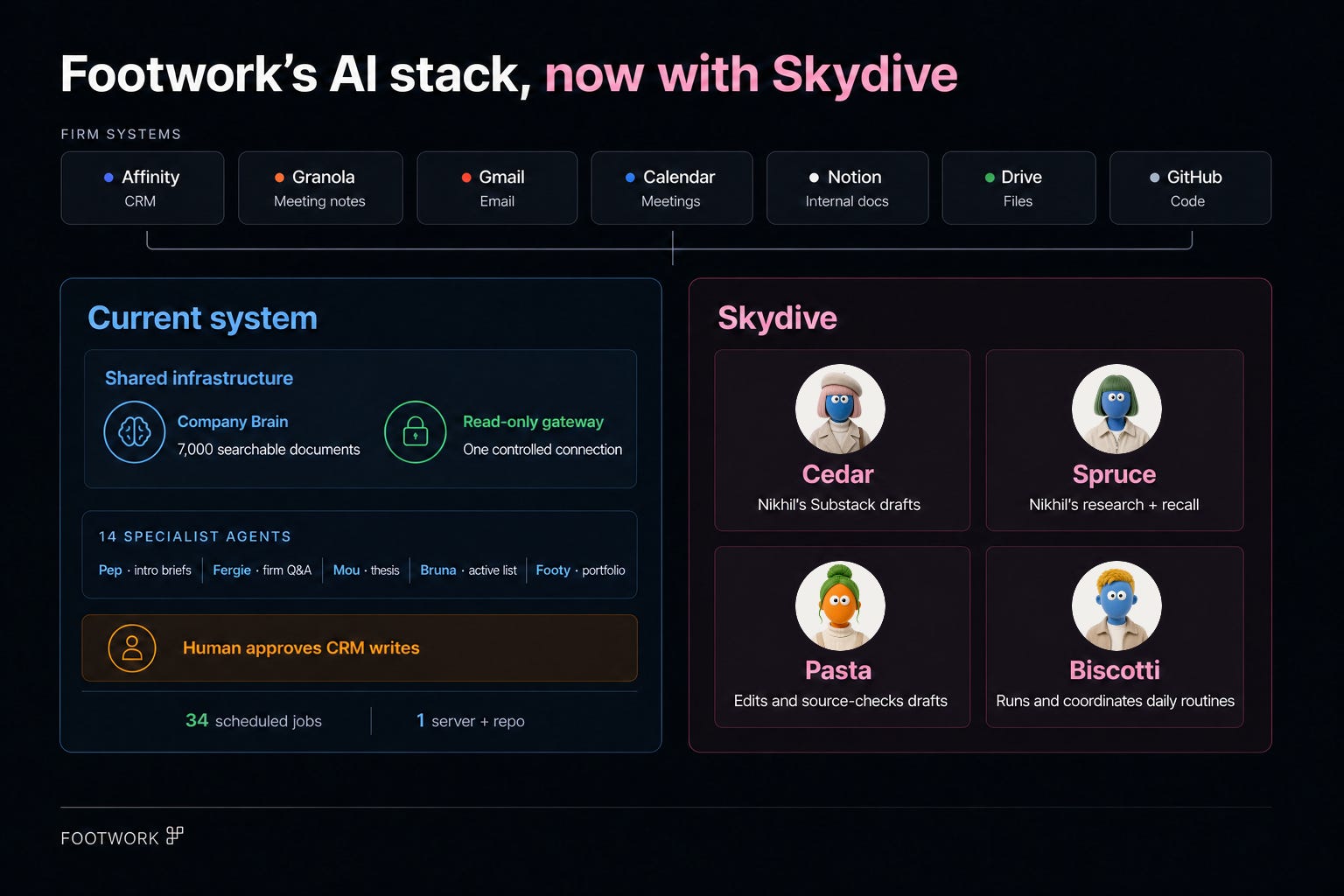
That got us a long way and then it reached an edge. Those agents run our systems well. But not one of them could open a browser, hold an inbox a person can just write to, or pick up work a colleague handed it in Slack.
That is what a week on Skydive added. We have four of those agents now, the oldest of them five days old, and there is no repository, no server and no pull request behind any of them. Building the first fleet took ten weeks — standing up the second took a week, and none of it was code we wrote.
The caution I wrote in March still stands. Human judgment is what drives investing outperformance, and I believe that more now, not less. Agents doing the grunt work raise the value of what makes us human, such as… yes… taste 🙂.
What separates Skydive from the noise?
There is a lot of activity in this category of agent building platforms right now — for example, companies such as Town, product launches from the labs such as Grok Bot, and building your own agents. We’ve tried them all, and they have their merits, but in a week of using Skydive, we’ve found it to be the platform we’re most drawn to keep using and building on.
With Town, for example assistant-to-assistant collaboration is between your Townie and someone else’s rather than between several agents you run yourself, and several agents that someone else on your team runs. Grok Bots share one user-scoped computer and run in parallel on it, whereas a Skydive agent gets its own computer. That is not about whether an agent has a machine. It is about whether one agent’s work is separated from the next one’s, which becomes the question the moment you are running four of them and two belong to somebody else. You can build agents yourself — Stripe has done this with Minions, Ramp with Inspect, and at Footwork we’ve done this too. But it is cumbersome to set up each agent to have its own ability to act, with its own inbox to email and number to text, and Skydive has enabled this for us.
The Skydive agents get better as they work. They can work together as a team. And, importantly in our own experience using several different products, it is just plain fun to work with them, and to see what they come up with, especially as they work together. We have Slack threads, such as the one to create this post, that feature more than 100 replies from our team of Skydive agents!

Try it
The team at Anything built Skydive to run their own company, and now serve over a million users with 1 human customer support agent and an army of Skydive agents. They realized that Skydive itself is a breakthrough platform, one that so many other companies can benefit from. And then this talented, small but mighty group of humans in San Francisco (and their agents of course!) painstakingly went to work to enable that to happen, with love and care built into the product such that it is launch-ready. More about the backstory in Fast Company here.
Skydive is live today for companies of any size at skydive.com. Make one agent, pick the job you would hand to a new coworker on their first day if you had one, and describe it. Then make the next one. Then have them collaborate with each other, and with other Skydive agents your colleagues are building. For Enterprise customers, Skydive gives your company one workspace for all your agents across departments, with centralized controls, visibility, privacy, and security.
Cedar wrote the first draft of this post, three other agents caught things I would have probably missed, but I rewrote the ending. That is the job now. The agents do the work, and you keep the taste. And you can have more fun in the process thanks to products like Skydive 🙃.
I started next big thing to share unfiltered thoughts. I’d love your feedback, questions, and comments!
👇🏽 please hit the ♥️ button below if you enjoyed this post.
Wow. This is a great example of how to make AI work for you. Working with your corporate applications. Customized for your team. Personalized for your work style. And yet, you remain in charge. Congrats Anything and Footwork teams. Keep going :-)
Great to see!